Heyyyo Fuckers!
Welcome back. Thank you for being here. We’ve returned with an artsy activity mapping your time.
Of course, last time we were going through a simple exercise to increase window of tolerance for embodiment, stress, and uncertainty, as well as nervous system regulation. Giving ourselves opportunities to challenge anxiety, do the opposite of what it tells us to, and finding out the real nature of living in a body, in time.
Because when you can’t trust your time or the impending ambiguity of what’s still to come? When you expect bullshit around every corner, for instance? It feels like you need to already have everything done already, always, in case shit hits the fan… which puts you at odds with the very reality of being alive (we can only experience it one task at a time). Which makes you feel like you aren’t allowed to be alive. You just need to be a means to an end, against the clock.
0/10 do not recommend.
But yeah, I know, the previous advice, as usual, was essentially “raw dog it through time until you understand what unadulterated experience within your many cages is like – until you’ve reconnected with the experience of being alive, calmly… then go try life again, sober from the drugs that distort your nervous system and mind.”
Is it revolutionary?
No!
Speaking to the foundational step for all progress to begin?
The answer is always “increase your window of tolerance for re-engaging your willpower. Get off these modern mind-altering substances, break behavioral patterns by doing what feels unallowed, refind the wiser voice in your being that you’ve been drowning out with mandatory survival actions, and then form a partnership with that guide by practicing listening to it… and re-take on life.”
All the inner work and self growth comes from there. That thing inside of you knows more than any of us can fathom and it is the only life coach you need.
So in this conversation we just had, the point is to get comfortable with time – with your estimates of yourself within time – with your freedom and right to be alive in it, using it how you see fit.
Instead of being crushed by it.
Let’s reframe these as markers of a too-fast outward pace compared to the system’s innate speed.
When we feel like we have to fling ourselves at tasks because there are so many and we don’t have the strength, energy, or resources to take them on calmly… we’re living in a mismatching time signature. We’re being pushed to play notes before we’ve set up proper playing form, cleaned our instrument, taken a deep breath, or learned the music.
And this can cause a freeze response.
Because we’re on stage, making fools of ourselves, racing while being pelted by the outside world.
This is a signal that time isn’t being felt or understood in the person. That they’re trying to align with a plane they’re not living on. To throw in another metaphor – why not – they’re trying to navigate roads that others can see, but not them, and blindly doing their best to stay on pavement.
Or. Anyone watch ANTM back in the day? Remember the go-see episodes? Flailing through unfamiliar streets? Falling up stairs? Making fools of themselves? That is what life feels like when your time isn’t your own – your life isn’t your own.
Until… you take it back. And build your own world.
…
…. Right, dramatic.
…
I realize this all sounds, also, like a lot of hoopla.
Until you do it.
And notice the difference.
So I wanted to give two more time-fear suggestions… and make them visual. Because time is so abstract. Let’s make it more definite. More solid. And also understand how your system is behaving through it each day, with empirical, somewhat measurable, information.
The first one? I’ve made it before, in the last time distortion series. You might want to check out that exercise episode, I remember it had some heartfelt suggestions. But here’s this one again because anyone can do it:
Switch to a physical planner. And actually use it. Create representations of tasks you need to do within the days, like creating squares that correlate with the time or energy required for each to-dun, instead of using wordy lists.
The point? To map out your day. To be able to allocate time. To see where there are spaces – opportunities – for using time in a new way.
And to get better at time estimating. If you combine this with the prior suggestion, you can start creating increasingly accurate time blocks through that standardization process.
Which is also the point of this next suggestion and the real activity of today…
Characterizing your time, visually… sortof similar to the way we just did it with the structures of your life last week.
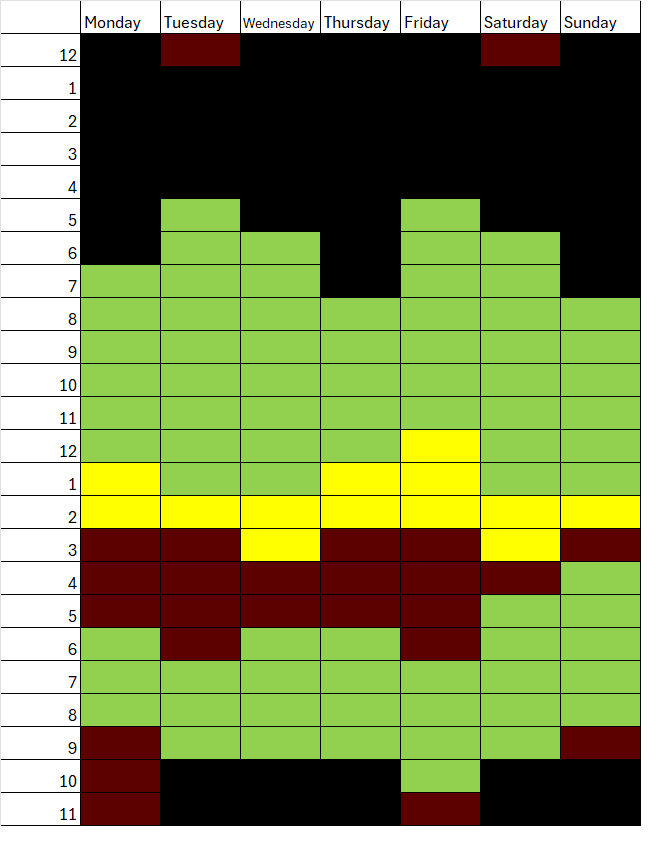
But this time, we’ll use a simple grid.
Each column or row, depending on what your brain prefers, is a day. Each square within that day is an hour.
And we’ll have seven columns or rows to map out a week.
I’ve created and attached a version for your usage.
And then… you guessed it… you’re going to color in the stupid squares for the stupid days.
I say stupid, because I know that this is another annoying suggestion. Which doesn’t make it any less useful.
My suggestion, though you can feel free to do this differently is:
You’re going to assess how your time passes. Not necessarily if it’s a good or a bad time, though you can feel free to denote that as well, perhaps with a +/- sign in each box. But the point is to describe any time distortions that you may host in a regular-ish week.
I recommend using a color coding system that represents speed intuitively: red, yellow, green. With extremes visually represented in tonal variations. Dark red? Going nowhere. Time has stopped. Bright green? Zipping through time-space without recognition of a minute of it. Yellow? Somewhere in between. A moderate experience of time. Maybe it’s slightly uncomfortable, but that’s the admission price of having feelings.
You might also want to take notes about your day when you do this coloring activity, but I’ll leave that up to you. The more observations you have, the better. So you might take this on at a time when you also feel like journaling... But you don’t have to; a digital record of your activities won’t be too hard to find if you aren’t recording in detail.
For, let’s say, a week, color the boxes, either as your day is unfolding or at the end of it, if you think you can remember accurately. You might recreate this in Excel (it will take roughly 90 seconds) and digitally fill them. Whatever works.
Then, when analyzing this data, compared against the activities you were engaging with, you can see what makes time expand or shrink for your mind. How pre-existing conditions like a bad night of sleep affect your experience. What behaviors are time-sucks for protective purposes. At what point in each day you might have dips in mood or mental willpower and require more support than you’re providing yourself.
You can pay more attention to those hours the next many times you live through them, take more detailed notes on environmental and emotional variables, and learn what’s going wrong instead of numbing through it.
Ya know, maybe it’s obvious. A certain meeting or a particular coworker interaction launches you into quicksand at a certain time each day. Or your commute. Or coming home to your living situation.
Or maybe it’s not so simple. It’s not an activity that’s the problem, it’s the approach you’re taking to being alive.
For example.. my mornings fly. I love them. My grid is alllllll green until about noon each day. And then it starts to turn yellow. And by mid afternoon it is a dark red bordering on black.
Time halts. I’m in an uncomfortable, fearful, state. Restless. Hyped up and also defeated. Unclear. Anxious. Emotionally wrought. I feel – with only slight exaggeration – like I would rather die than be here in my skin.
And this happens every day. And I’ve ignored it, knowingly, as much as possible, every day.
But when you see it colored out like this, it’s a lot harder to keep making excuses for living like that. For doing that to yourself.
So I started to pay attention.
What am I doing during those hours? No set activity, but sortof grinding through work that I don’t still have inspiration or energy for. I will stay busy somehow. I will keep pushing myself because my mind was conditioned by capitalism, so I MUST work until at least 5pm. (note: Even if I started working at 6am. The training really leaves a mark.)
Pretending I had a manager to impress and using time for cleaning instead of leaning, essentially. Even though I was already worked-out. The quality of the work? Not worth the strenuous effort.
It’s also worth noting, these were hours when I would mindlessly snack, uncontrollably. Because of the slow time? Yes. But also, I think, because I was burnt out but still estimating that I HAD to work, so my body would demand stress-calories trying to pre-fuel itself for endless effort. Wrong kind of fuel – what I was lacking wasn’t biological energy, necessarily. It was a fruitless effort that was keeping me in an overeating-overworking pattern.
So I started shifting my schedule around, trying to make the afternoon less miserable. Trying to extend the number of high quality, balanced, hours I have, rather than working as hard and fast as I can in the morning… getting exhausted and still forcing more of the same.
In the morning, I started trying to prevent myself from working before 9am. Sometimes writing calls and you have to answer. But around 2:30 or 3pm I started going for a walk – way later than before. Then, when we return, if my head has cleared up or found more words that it wants to share, I might work for a bit longer. Maybe even until right around bed time.
But it doesn’t feel so bad.
Because I’m working with the real pace of MY body and the processes inside. Instead of working off an outdated schedule that was served to me starting in public school in preparation for cooperative, unbothersome, desk jockeying.
And that recalibration has made the days a lot better. A lot more effective – I’m getting twice as much done, while feeling half as strained. Partially thanks to a much more standardized in the proceeding of time. Which is ALSO because I’m not bouncing off those time-crawling afternoon hours of rage and entrapment into opposingly rapid, disassociated, hours to soothe my discomfort. My time map isn’t going from dark, almost black-red to the brightest neon green as I dopamine binge to treat the burn, zipping through unnoticed hours at the end of the day, finally getting relief from the prison I’ve been keeping myself in.
Instead everything feels more… yellow, honestly.
Before I was aiming for bright green – time passing without noticing it. Which just means I wasn’t noticing myself, existing IN time.
Which is easy on the nerves. Just… not feeling.
But isn’t living.
We (as in, every mental health opinion haver) are always saying the key is to “slow down” – so, imagine a yellow stop light as the pace to your day. Take it easy, allow time for observation and adjustment. But keep moving. Calmly. Gently. With all the time you need.
Give it a try. See if you start to find times or behaviors that are crunching up your daily experience.
The only thing you have to lose? A torturously inconsistent relationship with your time that causes you to misuse and miss-out on your life.
Cheers.